The hard part
Edge platforms rewrite addresses and route requests in ways an ordinary local server does not. So a whole class of bug is invisible until after you go live, and the feedback loop for fixing it runs through a deployment every time. The only real answer is to make local behave the way production does.
The development server reproduces the platform's own clean-URL rewriting and worker proxying, so what is tested locally is what actually ships. Static-first, with the dynamic surface isolated at the edge.
Local and edge routing kept identical — deploys gated by environment — accessibility handled structurally on the inner pages
What the measurements mean
Only what is unusual for this project. Every sentence names the field it came from; nothing here is asserted that cannot be checked against the data.
- At 75,000 authored lines it is one of the larger things here, roughly 9x the median project in this estate. authored_linesfrom authored_lines
- It serves 4 HTTP endpoints and declares ports 3000, 5004, 8001, so it runs as a service rather than a script.see the evidencefrom assets.routes, assets.ports
- The code defines 70 functions, 11 methods and 1 class.see the evidencefrom pythonAst.counts, pythonAst.coverage
- It grades A, weakest on provenance at 71.4%. provenance coveragesee the evidencefrom grades
How it works
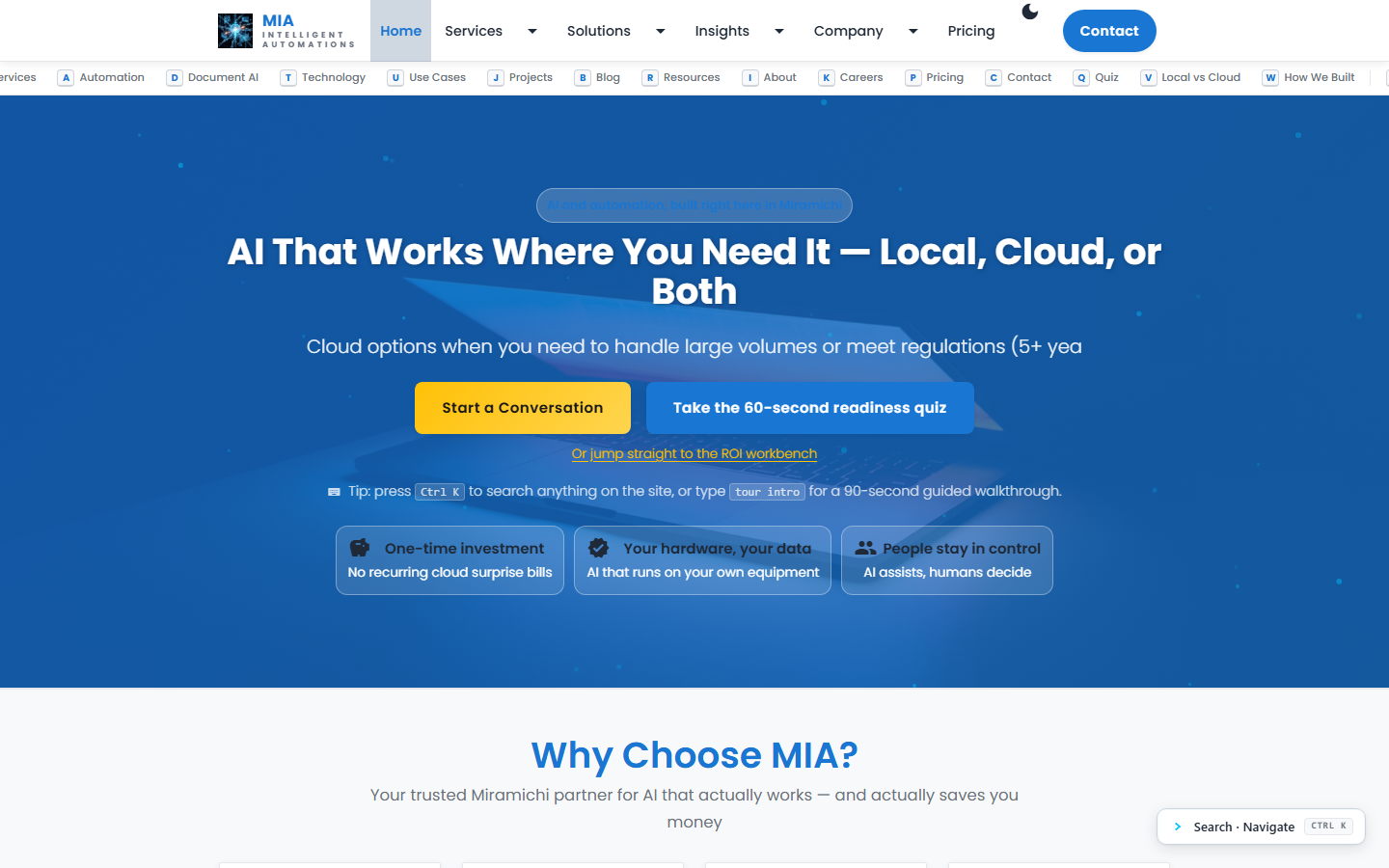
Edge platforms, which run a site on servers spread close to its visitors, rewrite addresses and route requests in ways an ordinary local server does not. A whole class of bug therefore stays invisible until the site is live, and every attempt to fix one goes through another deployment. The answer was to make local development behave the way production does. The development server reproduces the platform's own clean-URL rewriting and Worker proxying, so what is tested locally is what actually ships. The site is static first. Its dynamic parts, the chatbot and contact endpoints, sit in a Worker at the edge that proxies them to a FastAPI backend. Accessibility is handled in the structure, with skip links and keyboard navigation on the inner pages. Development and production deploys are separate. A production deploy asks for the word LIVE to be typed, and only public files are staged for publishing. Since October 2026 the home page speaks directly to local small businesses, with an invoice demo and a payback calculator whose examples are marked as fictional.
What kind of engineering this is
Six signals counted from the source: files that run models locally, that act without being asked each time, that check their own output, that survive failure, that touch parsers and protocols, and that were measured then improved. Every axis carries its file count.
The API, by shape
Routes read out of the source by a parser and grouped by their first path segment. They come from the code rather than the README, because a README can fall behind the code it describes.
What it is written in
Share of code bytes. Vendored bundles and generated output are set aside before this is computed, which is why it differs from a simple file count.
What stands out
- The local development server reproduces the platform's URL rewriting and Worker proxying.
- The site is static first, with its dynamic parts isolated in edge Workers.
- Development and production deploy separately, and production requires typing LIVE.
- Only public files are staged for publishing.
- The home page has an invoice demo and a payback calculator, with every example marked fictional.
Capabilities
- Skip to content
- Home
- Services
- View All Services
- Start a Conversation
- Solutions
- Insights
- Company
- Pricing
- Contact
Grade
Every check names the field it measured. Checks that cannot apply are excluded, never counted as failures.
- provenance71.4%
- documentation100.0%
- runnability100.0%
- maintenance100.0%
- integrity100.0%
Not met
- committed 22 uncommitted file(s), untouched 74 days; last commit 74 days ago
cd the project folder && git status
Architecture
Directories carrying real modules, largest first.
assets14 modules_cleanup9 modulestools3 modules(root)2 modulesbackend1 moduleworker1 module
HTTP surface
4 endpoints in total.
ROUTE /ROUTE /<path:filename>ROUTE /configROUTE /health
Vulnerable dependencies
12 declared dependencies match a published advisory. Checked offline against the OSV database; only pinned versions can be checked, so anything unpinned here is unknown rather than clean.
- Act now.
anyio4.13.0→ 4.14.2GHSA-5p39-cfhj-2xmp, GHSA-82r6-8w77-94w6, PYSEC-2026-4024 - Act now.
certifi2026.4.22→ 2026.10.18GHSA-6q48-6c7w-9gw2, PYSEC-2026-4320 - Act now.
nanoid3.3.11→ 3.3.16GHSA-28wg-ghj8-5hjv, GHSA-2v37-7h3g-55p8, GHSA-xwg4-73v4-xw9w - Act now.
pillow12.2.0→ 13.0.0GHSA-22hg-r758-rrw9, GHSA-24rc-8hj2-v98c, GHSA-254f-3936-288h - Act now.
postcss8.5.6→ 8.5.12GHSA-6g55-p6wh-862q, GHSA-fxqj-rqcc-2cmp, GHSA-qx2v-qp2m-jg93 - Act now.
python-multipart0.0.9→ 0.0.18GHSA-59g5-xgcq-4qw3, GHSA-5rvq-cxj2-64vf, GHSA-6jv3-5f52-599m - Act now.
soupsieve2.8.3→ 2.8.4GHSA-2wc2-fm75-p42x, GHSA-836r-79rf-4m37, GHSA-gjv8-xp57-g29c - Act now.
source-map-js1.2.1→ 1.2.2GHSA-68fv-2mgg-jv7q - Act now.
starlette0.38.6→ 1.3.1GHSA-2c2j-9gv5-cj73, GHSA-82w8-qh3p-5jfq, GHSA-86qp-5c8j-p5mr - Act now.
ws8.18.3→ 8.21.0GHSA-58qx-3vcg-4xpx, GHSA-96hv-2xvq-fx4p - Should fix.
idna3.13→ 3.15GHSA-65pc-fj4g-8rjx, PYSEC-2026-215 - Should fix.
pip26.1→ 26.2.0GHSA-qwm4-qh6w-59xr, GHSA-wf93-45jw-7689, PYSEC-2026-196
Vocabulary
Parsed 14 of 14 Python file(s).
Classes
DevHandlerdev_server.py:34__init__, do_GET, do_POST, do_OPTIONS, _safe_serve, _safe_headers, _safe_end, _safe_error
Functions
rootserver.py:13serve_filesserver.py:17_on_startupbackend/app.py:106_tokenizebackend/app.py:156_chunk_to_corpusbackend/app.py:161load_site_indexbackend/app.py:186_embed_querybackend/app.py:241_rrf_fusebackend/app.py:266search_chunksbackend/app.py:275format_search_for_promptbackend/app.py:340get_llm_clientbackend/app.py:363_get_httpxbackend/app.py:376detect_modelbackend/app.py:409model_familybackend/app.py:438prepare_messagesbackend/app.py:447extract_replybackend/app.py:485call_llmbackend/app.py:507_validate_nav_urlbackend/app.py:542_enforce_linksbackend/app.py:570fix_mdbackend/app.py:577chat_with_llmbackend/app.py:609summarize_sessionbackend/app.py:641healthbackend/app.py:685new_sessionbackend/app.py:697
Depth
Signals counted from the code, not asserted.
102 commits across 7 separate working days over 11.5 months, 49 of them revising existing behaviour
Built from scratch
- Custom indexing / search
- Concurrency primitives
Proves itself
- Golden / baseline files
- Smoke tests
Survives failure
- Fallback paths
- Timeouts
- Recovery / restore
- Logging / observability
- Retry / backoff
Local inference
- LM Studio
Systems
Environment engineering
- Virtual environments
- Dependency isolation
- Bootstrap scripts
Working within limits
- Timeout budgets
Networking
- Tunnels / reverse proxy
Distributed systems
- Worker orchestration
Operating-system internals
- Process control
Languages
- JavaScript6,376
- Python3,134
- Batchfile666
- PowerShell370
- Shell43
Built with
- FastAPI
- Flask
- Uvicorn
- NumPy
- BeautifulSoup
- Apache
- Cloudflare Pages
- Cloudflare Workers
- npm
- pip
Recurring themes in the commit history
- pages
- deploy
- page
- nav
- content
- keyboard
- backend
- hero
- footer
- quiz
Evidence
Taken from the code itself: a module docstring or the opening of the README.
MIA Intake Backend Serves chatbot (via LM Studio) and contact form submissions. Runs on port 8001, exposed via Cloudflare Tunnel as resume.rnsu.net.
At a glance
- Status
- maintained
- Primary language
- HTML
- First commit
- 2025-09-16
- Last activity
- 2026-08-31
- Domain
- Automation & scraping
- Agent docs
- CLAUDE.md, AGENTS.md, PROJECT_KNOWLEDGE.md, .claude, .superpowers